Thursday, December 18, 2008

My Cash Flow As A Flow Chart

I use a method of cash management that I've cooked up over several years of trial and error. It was inspired by a great book I found referenced in the footnotes of a terrible Robert Kiyosaki book (that said, I haven't read a good Kiyosaki book...) called, The Richest Man in Babylon by G.S. Clason. In that book is described a method of personal financial management that is very simple: take your entire income, allocate 70% of it to "living," 20% to paying off debts, and the remaining 10% is directed to investments that are "inviolate" - you never cash them out or spend that money.

I ran with the basic system for quite a while and it worked wonders for me. My consumption came under control, my debts began to shrink and my net worth steadily increased. Little by little I began personalizing the system though. I had questions about what to do with "left over" amounts - should one keep separate ledgers for each of the three categories and roll over remaining balances in each when the next pay day rolls around? What about the investments? Clason preached reinvesting all interest and dividends and only tapping that income stream when one is too old to work - what if one doesn't live that long? Why not tap the income now while leaving the principal alone?

Little by little, these questions led to the development of my hybrid Richest Man in Babylon personal finance management method (I haven't come up with a snappy name for it yet). It's a bit difficult to explain quickly, which sometimes frustrates me when I'm trying to explain it to people. I was thinking about that today when the idea occurred to me to flow chart my method.

So, here it is:
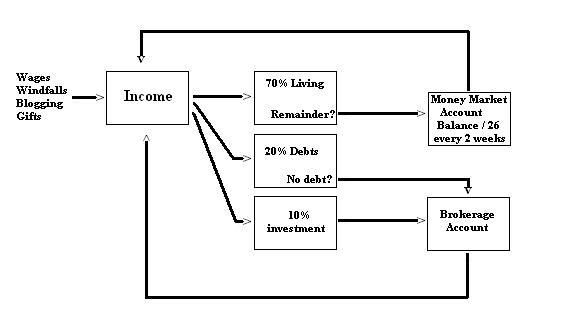


As you can see, at the core of the method is Clason's idea, the three categories broken down by his recommended percentages. The investment and debt categories are obvious; "living" encompasses everything you do in day-to-day life - eat, go to the movies, drive your car, etc., and all of the related expenditures. Clason's prescriptions really did end at this point, however, so I added some features to tie up what I saw as loose ends. The result is something that I believe can push itself past the point of requiring inputs (new capital) and can continue to grow on its own, barring human error.

So, the flowchart explained...

It all begins on the left with wages, money from blogging, "windfalls" (found money, lottery winnings, legal settlements, etc.), which are the "inputs" into the system from outside sources (not cash generated within the system loop itself - more on that later). Initially, the system will not run without regular, steady inputs (sorry, you've still got to go to work for a while!). Together they enter the system as "income."

Income then gets divided into the three categories already mentioned.

When it comes to the living allocation, after using Clason's original method for a few months, I found myself at a point where I had cash left over from a previous pay period in this category when the next pay period rolled around. At first it seemed great that I could just roll leftover cash into the category in the new pay period, but I noticed "boom and bust" cycles developing in my spending habits - when this category swelled, I started living it up, and eventually I would find myself reduced back down to just the 70% of my latest pay period. This is fine in one sense because I had created no new debts, but I didn't like being able to have fun one week and then be "in the black" but stuck at home anyway in the next.

That's when I came up with a notion of creating my own "paychecks" out of remaining balances from this category. My idea was to shuttle remainders off to a money market account if a remaining balance existed in the living category each pay period. Then, in between normal pay periods, I would divide the balance of the money market account by 26 - the number of pay periods I have per year currently - and draw the resulting amount, which then gets sent back to the income stage of my cash flow process and allocated among the three categories. The result is that irregular periods of plenty get spread out over one year's time rather than feeding boom and bust cycles, which have been all but eliminated from my financial life by this, and my debt and investment activities get a small boost since a percentage of these money market account withdrawals is allocated to them. Additionally, if something unexpected comes up that would exceed the cash in the living category - car repair, Christmas gifts, a new electric fireplace for your living room (yeah, I want one) - this account can be raided to provide for such things. This account is, after all, a pool of money that exists because of and for deferred consumption (but don't use that as an excuse to constantly raid the account!).

In the debt category, the only question I've ever had is, "what does one do with this category when there is no debt to pay off?" One couple in Clason's book who wrote about their experiences using his method desribed reallocating their income into just living and investing, at 80% and 20% respectively. This idea makes sense given Clason's admonitions to never touch the principal nor the interest and dividends of one's investments until old age, but for the way I treat that category (more on that in a moment), it made no sense at all - it gives one an increased standard of living from wages, but what about investing more while simultaneously having more money for living and potentially working less now? (Not to mention that one's wages might be stagnant for an extended period of time, meaning no increasing standard of living in the present). Instead, my plan is to divert the full debt category percentage into investments, achieving a 70% living and 30% investment cash flow allocation split, which will slowly increase the actual amount of the living category over time, as I'll now explain.

I like investing for income. I understand and appreciate compounding, and I know the advantage and benefits of pursuing capital appreciation; as such, I have accounts where that goes on, namely my IRA account that I have through work. Outside of that though, I prefer to pursue passive income investments that pay me now. My reasoning for this is rather simple: though the long term gains of such investing may be smaller relative to longer term, non-income oriented investing such as growth investing (and this is frequently the case), I am alive now, I may not be tomorrow, and I can boost my income and standard of living now by pursuing such investments whereas the other type offers a payoff at a point in time in which I may not be here anyway. Plus, pursued regularly and systematically, passive income investing can within one's lifetime reach a level where it continues to grow on its own even as it throws off more income than what is required to sustain one's day to day living.

So that's how I arrived at the last box in the chart, my brokerage account box where 10% of all of my income goes. I draw the interest and dividends generated by my investments from my various brokerage accounts and "send" them back to the income stage of my method. Thus, 70% of my passive income supports my daily living, 20% takes care of debts (if any), and 10% goes right back into my passive income investments (or 30% if there are no debts as I mentioned before). I achieve an increasing standard of living now while still getting some benefit of compounding, which increases my income, standard of living, and available cash for investing...

(If you haven't noticed, other than expenditures from the living category, and debt servicing, if any, all cash in my method eventually flows toward my investments, thus feeding the growing snowball...)

I think you see by now where this is going. Done right, I believe my method builds an ever-increasing income and standard of living, and my own experiences prove to me that this is the case. When I say "done right," however, I mean that, as there are several things that can derail this method: overspending in the living category increases debt; increased debt can lead to a situation where 20% of one's income is not enough to cover the payments, and having debt in the first place slows the growth of one's passive income; rash investment decisions can compromise your passive income stream and/or wipe out your capital, etc. This is no "autopilot" method; there needs to be an engaged human brain involved, a willingness to delay gratification, and patience.

Wednesday, December 17, 2008

Different Expectations, Different Preparations

I am told that we are experiencing a very unusual winter in the city of Walla Walla, WA. It's normally rather mild here in the wintertime with little snow and ice to worry about. Not so this year.

Expectations based on prior experience are frequently good enough to go on when it comes to making future plans. But how far should that be taken? Rather, when is it ok to plan and prepare for the worst while hoping for the best, to commit resources to that sort of thing?

I was in neighboring Columbia County today while out and about on the job. They're at a higher elevation than we (consequently, they get snow every winter), and I got up even higher by heading into the Blue Mountains to check in on one of my accounts. I shot this photo on one of those mountain roads:


Snowy, and a bit icy, but you can see the road surface. I was about ten miles out of town at this point in an area where there are few residences, and yet the road had been cleared by road crews.

And after that, oh, deer...


Oh my.

I digress...

So the reason I took such an interest in that mountain road is that it, as remote as it is relative to the nearby town (Dayton, WA), is far better cared for than the streets of my city right now:


I've seen just three plows out and about since this weather began this last Saturday morning, and the three of them were all together in one place hardly doing anything. I can understand that the city would not prioritize this sort of thing very highly in their annual budget since such events are supposedly rare, but I ask again, when is it reasonable to go ahead and spend on preparation for problems that may be infrequent?

In the grand scheme of things, maybe it doesn't make much sense for the city to invest in machinery and whatnot to deal with snow. Maybe the loss in sales taxes and property damage costs during these events is minuscule compared to the potential expense of purchasing, operating, and maintaining snow removal equipment. That being the case, I would much rather they not bother.

So then I think the questions come back around to me: what should I invest in to make these things impact my life less? Where's the line between good allocation of my resources and missed opportunities elsewhere? How much comfort is worth preserving and what is an unreasonable amount of voluntary hardship?

It'll be something to think about when I'm stuck in traffic waiting for someone to get their car moving forward over the ice, I suppose.

Tuesday, December 16, 2008

Dragon Naturally Speaking: Voice Recording to Text!


I saw this video, created by a gentleman by the name of Brett Bumeter, about how he uses a recording device with a speech-to-text word processing program I've blogged about before, Dragon Naturally Speaking. Previously I was under the impression that one would need a laptop or a similar device - something containing a CPU - to use this software on the go; Mr. Bumeter demonstrates why it's actually much simpler (and cooler) than that.

Basically, Brett just hooked up a headset with a microphone to a voice recording device (I'm not exactly sure what the device is that is featured in the video - some sort of mp3 player/recorder I assume), then he transferred the resulting sound file to his computer, connected his "audio out" port directly to the microphone port, then let Dragon Naturally Speaking transcribe the audio as if Brett was speaking it into the microphone himself. Genius! This makes the "portability" of Dragon Naturally Speaking that much more so since this example demonstrates how it is that lugging a computer around is not necessary for composing speech-to-text documents on the road.

Dragon Naturally Speaking 10 Basic with Discount Coupon Code

I'm still very interested in acquiring this software for my own use - just today I thought of several blog posts while driving around on the job, but have since forgotten all of them. With this setup, I could have simply spoken my thoughts into a microphone and then fed them through Dragon Naturally Speaking; no more lost blog posts! Since Christmas is so near, I am reluctant to spend on myself for anything, just in case someone buys me any of the things I am interested in as a gift, so if someone out there is paying attention to my "wish list" of stuff that I blog about, try one of these coupon codes...

...and save money! (I've blogged before about how people spending money on me makes me uncomfortable, so if one of my friends or family is getting me this, please, save money!)

Fed Funds Rate Between 0 and .25%: Wipe The Slate Clean

It happened: the U.S. Federal Reserve has turned us into Japan.

(I really think so!)

What I mean is that Japan's central bank has maintained a very loose monetary policy for years and years, charging less than 1% for the Yen. Now that we're lower than they are, the U.S. Dollar will likely become worth less and less. Inflation? You bet.

What got us here is debt. Both public and private, there's tons of it and the events of late are the consequences. Lowering the Fed funds rate could help or it could not, but that really depends on what all of us do with the opportunities this is likely to bring about.

Very simply, if offers of cheap credit start coming down the pipe, take them, but don't go forth and consume; consolidate and eliminate. Get rid of your debts when it is cheap to have them, since tacked-on interest will not build up the balance as fast, and then don't go into debt again.

Consolidate, refinance, defer purchases and pay with cash, do whatever you have to do, but when the siren song of cheap credit is encouraging you to spend and worry about it tomorrow, don't listen. This is tomorrow. This may be our chance to rebuild our personal financial houses on rock and not on sand where we've had them for so long.

As for our wasteful, bloated government... well, put your house in order, then vote that experience the next time around.

Monday, December 15, 2008

The Best Kind of Cell Phones: Free Cell Phones

Now that I'm driving about on snow and ice - despite thinking I had left all of that behind when I moved here from my former home - I've once again come to appreciate a basic piece of my work equipment that could be the difference between life and a freezing death in a ditch somewhere: my cell phone.

I haven't had a personal cell phone for quite some time now, and I do not use my work cell when I am not out and about on the job. So I'm looking into some free cell phone deals that are out there, which really appeal to me since I don't like paying for something and then paying again and again every month to use it - I'll do one or the other, but I prefer to not do both.

When trying to find the best cell phone plan deals for me, I look for plan features that fit my typical cell phone use habits, which include infrequent calls and short conversations (I don't like being on the phone). I don't really have a preference of carrier other than the different plans they might offer, be it att cell phones or some competitor of theirs. From one carrier to the next the features are often the same, so whatever the first I come across offers, chances are an entity like verizon cell phones would offer it, too. It's hard to go wrong with cell phones plans for me on the minimal service end of the spectrum, but further down the line with the pricier packages, like the kind that typically come with BlackBerry phones, it's too easy to waste money.

But I don't want to go too cheap and end up with only a few minutes each month. It would be ridiculous if a casual conversation at one point in the month put me in a bind later in the month when I find myself needing to make a call but I've used up my time allotment. I'm sure I could just pay a one-time charge for the time over my plan limit, but who wants to do that? I want minimal expense and maximum utility, not a per-call "gotcha!" device that empties my wallet.

That Other Snow Hazard: Cranky People

It started snowing early Saturday morning here in Walla Walla, and it pretty much has not stopped since. Temperatures have been in the teens (that's Fahrenheit, so for you Celsius types, we're in negative temperatures) and show no sign of changing for the better soon. Global warming? I wish.

I haven't lived in Walla Walla during the winter time before now, so I've been asking people who have lived here a while if this weather is unusual. They've all told me that it is. The typical winter here is a little cold, a little frosty, fairly rainy, but rarely does it snow and freeze solid.

People here are generally friendly, too. These last few days, however, they've been anything but. Just about every person I have interacted with in the last 48 hours has been cranky. Since the winter we're having is unusual for the area, I can only assume that it is the snow and the cold that is making everyone miserable (and the lack of city snow removal equipment, despite their insistence that they really do own plows and de-icing trucks and whatnot). And since I moved here from a place that regularly turns into viking Hell, I guess I notice how off-center these people seem since, coming from my background, this winter isn't really all that much to be upset about.

Take it as another reason to welcome and encourage global warming: cold people are pissed off people.

Monday, December 08, 2008

Cryo-Cell: Murder-Free Stem Cell Treatments for Breast Cancer Soon?

I read recently that Cryo-Cell, a company that bills itself as "America's Most-Established Family Cord Blood Bank" is partnering up with the National Institutes of Health to launch groundbreaking research into using stem cells collected from menstrual blood in the treatment of breast cancer, a dreadful disease that strikes hundreds of thousands of women and a few thousand men in the U.S. each year. What will be unique about this study is that new techniques for tracking the paths of stem cells introduced into the human body through magnetic resonance imaging will be used, which if successful will allow researchers to gain greater insight into the proper application of menstrual blood stem cells in treating diseases.

I've blogged about this company before, and I'm glad to see that they're still working hard at finding methods of harvesting useful, potentially life saving stem cells without resorting to destroying human embryos to get them. Work such as this further undermines the pro-abortionist argument that we need to create human embryos only to destroy them to get stem cells, which implies that destroying embryos is the only way to get stem cells; a counter example where stem cells are gotten by another method is all that is required to prove this argument wrong. There are other ways, they're increasing in number all the time, and companies such as Cryo-Cell are leading the charge.

NRA for Life

Last night I finally did something that I probably should have done years ago: I joined the National Rifle Association.

I've been shooting since I was eight years old when my dad bought me my first BB gun, hunting small game with a .22 caliber bolt action rifle since I was 12, and I've been hunting large game and game birds with various big game rifles and shotguns since I was 15. I've been a firearms enthusiast and owner for the majority of my life, and I've watched in horror as gun control advocates and their largely misinformed, fear driven supporters chipped away at our most important freedom. Yet, until now, I haven't done much about it except argue with those in my immediate vicinity. That's something, I guess, but it's not enough.

I signed up for a lifetime membership in the NRA. Anyone familiar with the price of a lifetime membership may have just had their chin land on their desk, but what I want to draw attention to with this post is the roughly $8.33 per month cost of becoming a lifetime NRA member.

Yes, you read that correctly. While signing up for the NRA, I noticed an "easy payment plan" option for the lifetime membership - you pay $25 to join right now, then the NRA will mail you a quarterly invoice for $25 until the full $1,000 lifetime membership amount is paid in full. $25 per quarter works out to about $8.33 per month, or in terms of typical employment pay periods, roughly $4.17 each paycheck. If you're a hunter, shooting sports enthusiast, gun collector, or even if you don't own and/or have never shot a gun but you understand the importance of private firearms ownership for maintaining our freedom, don't you think it would be worth skipping one trip to Starbucks every other week to support an organization like the NRA?

Go here for more information or to sign up. The incoming Obama administration is very likely to launch one attack after another on this basic right of every individual American, and it's going to take all of us working together to stop them from disarming us and leaving us at the mercy of criminals and, perhaps worse, our own government.

Sunday, December 07, 2008

How To Tell Time In A Cave

On Wednesday of this coming week I am to kick off the "underground" portion of the pigeon control contract I'm working under with the city I live in, Walla Walla, Washington. I'll be going into tunnels that are part of flood control channels that run under and through this town. Pigeons have set themselves up within these tunnels. Someone has to go in there and clear them out. That someone is me.

All of this has to be coordinated with several agencies: the Army Corp of Engineers, the county public works folks, local law enforcement (because I'm using a rifle, albeit only a pellet rifle). It's a "set schedule" sort of affair, something that can only be done when all involved parties know that it is being done. As such, I have two days picked out this month on which I will venture down into these tunnels, and a set number of hours each time that I'll be active. All of this has been set up in advance, permits have been secured, official signatures acquired, the whole nine yards. Normally I see these sort of procedures as an annoying hassle, but in this case, the more people who know that I am walking around inside of the city's flood control channels and tunnels, the better.

So I have to keep track of the time, and in the dark that can be a bit of a challenge. I may pick up something like a Luminox watch to do this, its glowing face and water resistance being ideal for the environment I'll be working in. It's a bit pricey, but since the potential penalty for not being out of the tunnels in time is to be flushed down river by a release of water from a local dam, I'm sure it's worth every penny!

Saturday, December 06, 2008

Gun Owners, Please Watch This Video


This is a warning from our friends down under and across the pond. The false promises of gun control led to their losing their rights, and what happened to them can happen here in the United States. It is more likely with Obama soon to be in office that there will be a series of attacks on the 2nd amendment. Hear this warning and get motivated - this cannot be allowed to happen here!

Friday, December 05, 2008

Forex the Slow Way

I haven't written anything in a while now about my Forex trading activities. That's mostly because the methods I'm using don't inspire much to write about. I'm still primarily focused on collecting daily interest from carry trading, and as always I'm on the lookout for ways to boost the yield and increase the safety of my trades.

Over the last several weeks Tony of Get Swinked! and I have been working over our methods, comparing notes, and sharing ideas. Recently Tony came up with the idea of looking for opportunities to open positions at historical extremes of price for a given currency pair with the intention of holding those positions deep in profit as price moves back toward normal ranges where more typical trading could occur. The idea is that with several trades in a currency pair sitting in profit, earning interest, one is both more free and more protected against loss while going for riskier, shorter term trades in that same pair.

Recent global financial events have provided a great deal of price extremes (my favorite pair, USD/TRY held short, being one incredible example of this). This gave us opportunities to test the idea, which right from the beginning I thought was (is) brilliant. The only thing I didn't like was the possibility of further price moves putting once profitable positions in the red, meaning new positions would have to be established further out at the new price extremes. Because I wanted as few positions in the red as possible, and the most free margin available to open new positions in the face of greater opportunities, I decided to use what Tony and I now call "protective stop losses" ("psl's" for short). Psl's are, quite simply, stop loss orders put only a few pips in profit on profitable positions. The idea is to decrease the likelihood that the orders will be triggered by snap retracements, allowing the positions to remain open and earn interest, but they will protect against price moves that carry the action past the trade's opening point and into the red. Instead, a small profit is taken, plus earned interest, and the margin used is free again to reopen the position at the new, better price.

We're still working this idea over, experimenting with relative strength indicators and some simple moving averages to try and figure out the best times to attempt to establish these permanent positions, but so far the results have been very good. Ultimately, what I hope this could lead to is a 100%+ leveraged account - all margin in play, plus positions opened on the unrealized gains of older positions, all protected with psl's to prevent disaster. If this can be pulled off, relatively small amounts of margin on deposit could potentially yield unimaginable amounts of interest. I'm looking forward to trying!

Search Paul E. Zimmerman.com

Loading...
Disclosure Policy - Privacy Policy
jenna jameson chasey lain tera patrick briana banks sunny leone lanny barby stefani morgan savanna samson monique alexander cassidey